SLAP Tear Treatment in Bangalore
You reach up to serve, throw, or lift something overhead, and there it is again — that deep, nagging pain inside your shoulder. It’s hard to pinpoint exactly where it hurts, but you know something isn’t right. Sometimes there’s a clicking or catching sensation, and your shoulder feels weaker than it used to.
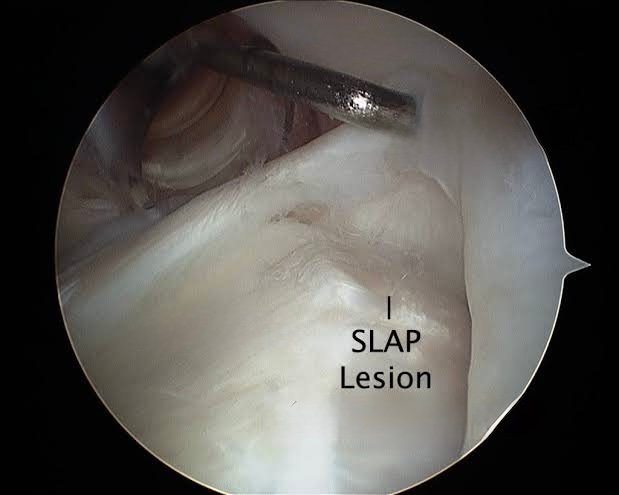
This is often how a SLAP tear presents. The acronym stands for Superior Labrum Anterior to Posterior — a tear in the ring of cartilage that lines your shoulder socket, specifically at the top where the biceps tendon attaches. It’s a common injury in overhead athletes and anyone who does repetitive lifting or throwing, but it can also happen from a simple fall on an outstretched arm.
The tricky thing about SLAP tears is that they’re not always obvious. Symptoms overlap with other shoulder conditions, and many people walk around with a tear for months without realising it. At our clinic in Bangalore, Dr. Raghavendra Kembhavi takes a careful, methodical approach to diagnosis — because getting the right treatment starts with getting the right diagnosis.
What is the labrum, and why does it matter?
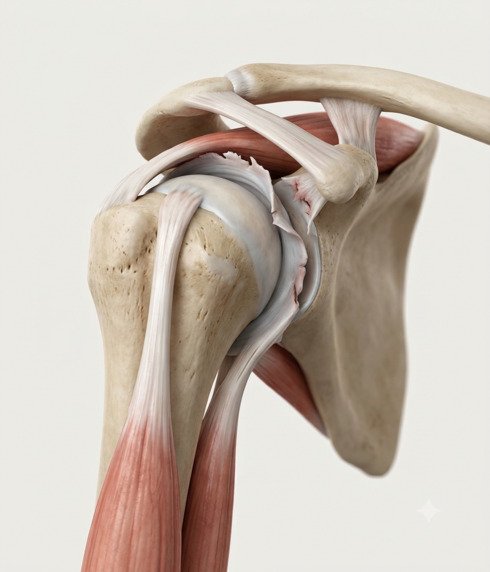
Your shoulder is a ball-and-socket joint — but unlike the hip, the socket is shallow. The labrum is a ring of fibrous cartilage that lines the rim of that socket, deepening it and providing stability. It also serves as the attachment point for the biceps tendon at the top.
When this ring tears at the top — from the front (anterior) to the back (posterior) — it’s called a SLAP tear. The biceps anchor can become unstable, leading to pain, weakness, and that characteristic catching sensation with overhead movements.
SLAP tears are classified into four main types, depending on the pattern and severity of the tear. Type I involves fraying but the labrum remains attached. Type II — the most common — is where the labrum pulls away from the bone. Type III is a bucket-handle tear, and Type IV extends into the biceps tendon itself.
Signs and symptoms of a SLAP tear
SLAP tear symptoms can be subtle and easily dismissed as a strain or tendinitis. They often develop gradually rather than appearing suddenly after a single incident.
Deep shoulder pain
A vague, aching pain deep inside the shoulder that’s hard to pinpoint. It often worsens with overhead activities.
Clicking or catching
A popping, grinding, or catching sensation when you move your shoulder, especially overhead.
Weakness and fatigue
Your shoulder may feel weak, and your arm tires quickly with repeated overhead movements like throwing.
Loss of throwing accuracy
Athletes often notice a drop in power or accuracy with throwing — the ball just doesn’t go where it used to.
Diagnosis
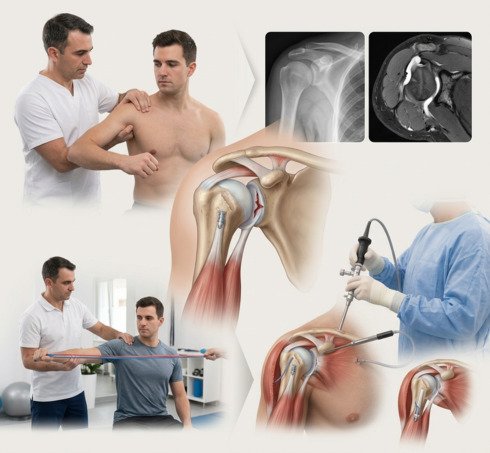
SLAP tears are notoriously difficult to diagnose. The symptoms overlap with rotator cuff problems, biceps tendinitis, and other labral injuries, and no single physical test is definitive. Dr. Raghavendra Kembhavi begins with a thorough history and clinical examination, using specific provocative tests like the O’Brien’s test and Speed’s test to build a picture of what’s happening inside your shoulder.
Imaging and confirmation
Standard X-rays are usually normal in SLAP tears — they don’t show soft tissue. An MRI arthrogram, where contrast dye is injected into the joint before the scan, is the imaging study of choice. It can show whether the labrum has pulled away from the bone and whether the biceps anchor is involved.
Treatment approach
Not every SLAP tear needs surgery. For many patients — especially those with Type I tears or lower activity demands — a structured physiotherapy programme can be effective. The focus is on strengthening the rotator cuff and scapular stabilisers to compensate for the labral damage and restore shoulder function.
When surgery is considered
If conservative treatment fails, or if there’s a significant Type II tear with instability, arthroscopic repair may be recommended. Dr. Kembhavi performs these procedures using keyhole techniques, reattaching the torn labrum to the bone with suture anchors. In some cases, particularly in older patients or those with biceps involvement, a biceps tenodesis — repositioning the biceps tendon — may be performed instead of repair.
Why choose Dr. Raghavendra Kembhavi
Fellowship-trained in shoulder arthroscopy
Dr. Kembhavi has received advanced training in arthroscopic surgery and sports medicine. This means he’s skilled in the latest keyhole techniques for the shoulder — smaller incisions, less pain, and faster recovery for his patients.
A focus on joint preservation
Not every SLAP tear requires surgery. Dr. Kembhavi’s approach is to explore every conservative option first, reserving surgery for cases where it’s genuinely needed. When surgery is required, the goal is to repair and preserve — not replace.
Accurate diagnosis matters
SLAP tears are often misdiagnosed because their symptoms overlap with other shoulder conditions. Dr. Kembhavi takes a thorough approach, combining clinical examination with advanced imaging to get the diagnosis right before recommending treatment.
Personalised rehabilitation
Recovery from SLAP surgery requires patience and a structured rehabilitation programme. Dr. Kembhavi works closely with physiotherapists to ensure you get a personalised plan that protects the repair while restoring strength and function.