Hip Muscle Tear Treatment in Bangalore for Pain and Weakness
Hip muscle injuries and tears can cause pain, tenderness, weakness and difficulty with everyday movements or sports activities. These injuries may involve muscles or tendons around the hip, and treatment depends on the affected tissue and severity of the injury. Dr. Raghavendra Kembhavi provides orthopaedic evaluation for hip conditions and discusses appropriate treatment options based on the diagnosis. If you are looking for hip muscle injury treatment in Bangalore, consult the clinic to understand the available care options.
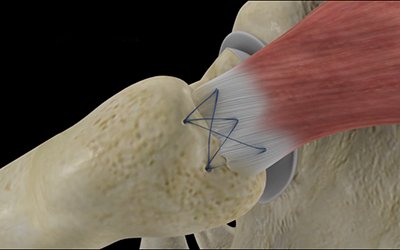
Types of proximal hamstring injury
Type 1
Tendinopathy
Degenerative change within the proximal hamstring tendon, usually from chronic overload. Causes deep buttock pain with sitting and exercise. Treated with load management and physiotherapy.
Type 2
Partial tear
A partial thickness tear of one or more of the proximal hamstring tendons. Causes acute-onset buttock pain. May be managed non-surgically if the tear is small.
Type 3
Complete avulsion
The hamstring tendons pull completely off the ischial tuberosity — often with a palpable gap and significant bruising. Surgical repair is typically recommended for active patients, ideally within 4–6 weeks of injury.
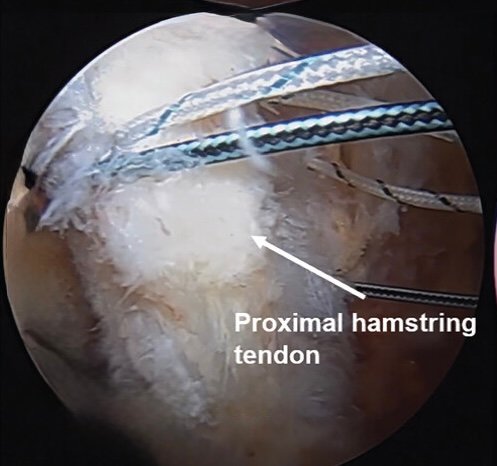
Common Symptoms of Hip Muscle Tears
Acute buttock or upper thigh pain after a sprint, lunge, or fall (acute avulsion)
Deep ache in the buttock with sitting on hard surfaces (chronic tendinopathy)
Weakness in hamstring function — difficulty with running, climbing stairs, or bending the knee against resistance
Bruising down the back of the thigh after acute avulsion
Diagnosis of Hip Muscle and Tendon Injuries
MRI is the primary investigation, clearly demonstrating the degree of tendon damage, retraction of avulsed tendons, and any associated injury. Ultrasound is useful for dynamic assessment and guided injections.
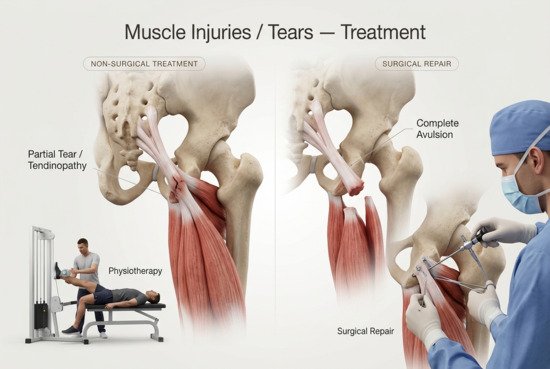
Non-Surgical Treatment Options for Hip Muscle Tears
Non-surgical: Partial tears and tendinopathy are managed with structured physiotherapy — eccentric loading programme, progressive return to sport. Recovery takes 3–6 months.
Surgical repair: Complete avulsions in active patients are best repaired either endoscopically or open depending on extent of tear and chronicity which includes surgically reattaching the tendons to the ischial tuberosity with suture anchors. Early repair (within 4–6 weeks) produces the best results. Delayed repair is technically more challenging but can still be performed in carefully selected patients.
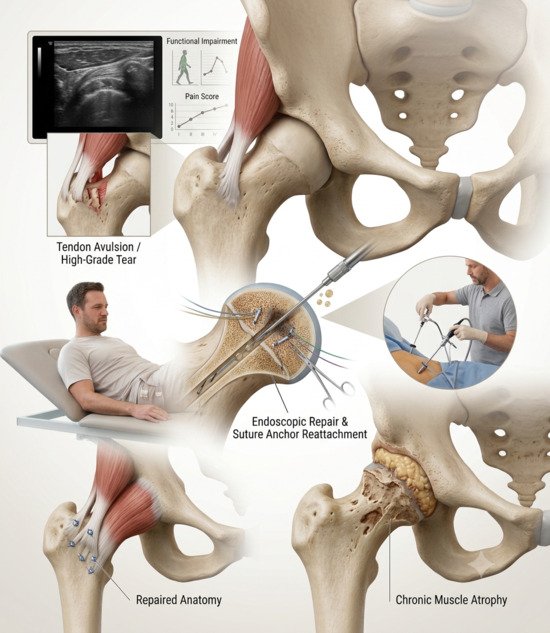
Gluteus medius tears
Gluteus medius tears are part of the spectrum of greater trochanteric pain syndrome (GTPS) and are essentially a form of hip abductor tendon pathology. They can range from tendinopathy and partial-thickness tears to complete avulsion.
Problems in such patients include
- Lateral hip pain over the greater trochanter
- Pain when lying on the affected side
- Pain with prolonged walking, running or stairs
- Difficulty with single-leg stance
- Weakness of hip abduction
- Trendelenburg gait/sign in significant tears
- Pain with resisted hip abduction
Generally such patients have preexistent tendinopathy which gets worsened into complete tear following traumatic episodes.
Diagnosis
MRI is particulary helpful in diagnosis of gluteus medius tears eventhough sometimes tears are concealed and it is difficult to pick up even in MRI.
Treatment
Depends on extent of tear and symptomatology.
Conservative
- Activity modification
- Progressive abductor strengthening
- Avoid prolonged compression of the tendon
- NSAIDs/analgesia when appropriate
- Management of contributing biomechanics
Operative indications
Consider repair when there is:
- Persistent disabling pain despite adequate conservative treatment
- Significant abductor weakness
- Trendelenburg gait
- High-grade partial or full-thickness tear
- Acute traumatic avulsion in an appropriate patient
Surgical options
Endoscopic repair is challenging and minimally invasive technique for suitable tears.
Torn tendon is repaired back to the bone with suture anchors .
Dr Raghavendra Kembhavi share vast experience is diagnosing and treating such underdiagnosed conditions of muscle tears around hip.