Biceps Tendonitis & Proximal Biceps Rupture Treatment in Bangalore
You feel it at the front of your shoulder — a sharp, nagging pain that flares up when you lift something overhead or reach behind your back. Sometimes there’s a clicking or snapping sensation, and your arm just doesn’t feel as strong as it used to. In more dramatic cases, you might have felt a sudden pop, followed by a bulge in your upper arm that wasn’t there before.
These are the signs of biceps tendon problems — either tendonitis, where the tendon becomes inflamed from overuse, or a rupture, where the tendon actually tears away from its attachment. Both conditions can significantly affect your daily life, but the right treatment can make a real difference. At our clinic in Bangalore, Dr. Raghavendra Kembhavi specialises in diagnosing and treating biceps tendon pathology, from conservative care to advanced arthroscopic repair.
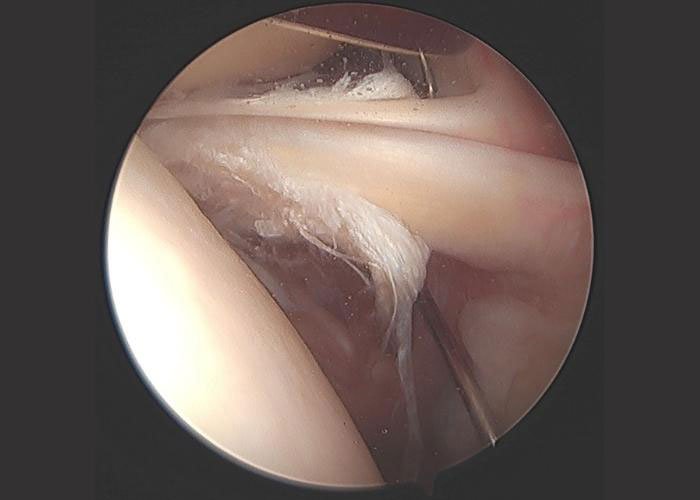
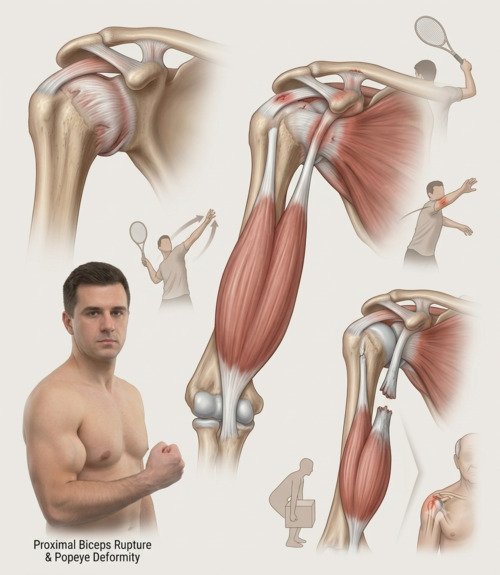
What causes biceps tendon problems?
Your biceps muscle has two tendons at the shoulder (the proximal tendons) and one at the elbow (the distal tendon). The long head of the biceps is the one that most commonly causes trouble — it runs through a narrow groove at the front of the shoulder and is vulnerable to irritation and wear.
Biceps tendonitis is inflammation of this tendon, usually from repetitive overhead activities. It’s common in athletes who throw, swim, or play racquet sports, but it can also develop from everyday activities that involve repeated reaching and lifting. Importantly, biceps tendonitis rarely happens alone — it’s often accompanied by other shoulder problems like rotator cuff tears or impingement.
Proximal biceps rupture is when the tendon actually tears away from its attachment. This can happen suddenly — lifting a heavy object or a fall — or gradually as the tendon weakens from years of overuse. In older adults, degenerative changes make the tendon more prone to tearing. The classic sign is a “Popeye deformity” — a bulge in the upper arm where the muscle has bunched up after the tendon detached.
Signs and symptoms
The symptoms of biceps tendonitis and rupture overlap in some ways, but they have distinct features. Knowing which one you’re dealing with helps guide the right treatment.
Front shoulder pain
Pain or tenderness at the front of the shoulder that worsens with overhead activity or lifting.
Clicking or snapping
A sensation of clicking, catching, or snapping in the shoulder, especially with rotation.
Sudden pop with bulge
With a rupture, you may feel a sudden pop followed by a bulge in the upper arm (Popeye deformity).
Weakness with lifting
Noticeable weakness when lifting or pulling, especially with palm-up motions like using a screwdriver.
Diagnosis
Biceps tendon problems are often diagnosed clinically, but imaging helps confirm the diagnosis and rule out associated shoulder conditions. Dr. Raghavendra Kembhavi begins with a detailed history and physical examination, including specific tests like Speed’s test and Yergason’s test that reproduce the pain.
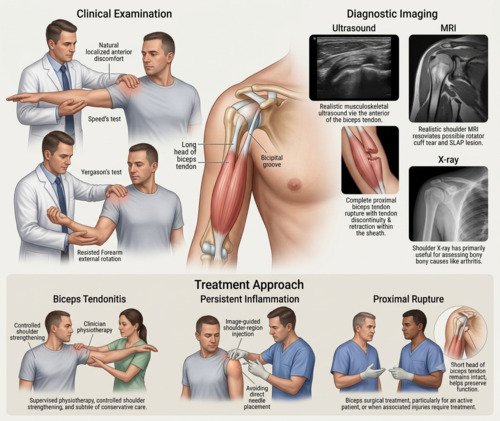
Imaging and tests
Ultrasound is often the first choice — it’s accurate for diagnosing complete proximal biceps tendon tears and can be done in the clinic. An MRI is useful when there’s suspicion of associated injuries like rotator cuff tears or SLAP lesions, which commonly occur alongside biceps tendon problems. X-rays may be ordered to rule out arthritis or other bony causes of shoulder pain.
Treatment approach
Treatment depends on whether you have tendonitis or a rupture, your age, activity level, and whether other shoulder structures are involved. For tendonitis, the first step is always conservative — rest, activity modification, anti-inflammatory medications, and physiotherapy. Steroid injections can help, but direct injections into the tendon are often avoided because they can weaken it and increase the risk of rupture. For proximal ruptures, conservative treatment is sometimes appropriate if one of the two proximal tendons remains intact, which can maintain function. However, surgery is often recommended for active individuals, or when there are associated shoulder injuries.
How biceps tendon problems are treated
Step 1
Rest & Activity Modification
Avoiding overhead lifting and repetitive activities that aggravate the tendon. This is often the first and most important step.
Step 2
Pain Management
Anti-inflammatory medications and ice to reduce pain and swelling.
Step 3
Physiotherapy
Targeted strengthening of the rotator cuff and scapular stabilisers. Range-of-motion exercises to prevent stiffness.
Step 4
Injection (If Needed)
A corticosteroid injection into the subacromial space can provide relief. Direct tendon injections are avoided to prevent weakening.
Step 5
Biceps Tenodesis
Surgical reattachment of the tendon to the humerus. Performed arthroscopically, it addresses the pain source while preserving biceps function.
Step 6
Rehabilitation
A structured physiotherapy programme to protect the repair and restore strength, with a gradual return to activity.
Biceps tenodesis vs. conservative treatment
| Factor | Biceps Tenodesis | Conservative Treatment |
|---|---|---|
| Best for | Active patients, failed conservative care, associated shoulder injuries | Mild tendonitis, older or lower-demand patients |
| Pain relief | Direct removal of the pain source; reliable results | Gradual; may take weeks to months |
| Recovery time | Sling 4 weeks; full recovery 4–6 months | No downtime; symptoms settle with therapy |
| Strength preservation | Preserves biceps function by reattaching the tendon | Relies on remaining tendon and muscle compensation |
Why choose Dr. Raghavendra Kembhavi
Individualised treatment decisions
Biceps tendon pathology rarely occurs in isolation. Dr. Kembhavi takes the time to assess the entire shoulder — the rotator cuff, labrum, and other structures — because treatment decisions are best made when the full picture is known. Tenotomy and tenodesis show similar functional outcomes at one year, but the choice depends on your age, activity level, and preferences.
Arthroscopic expertise
When surgery is needed, Dr. Kembhavi performs biceps tenodesis arthroscopically, using keyhole incisions to reattach the tendon with minimal disruption to surrounding tissues. This approach allows faster recovery and less post-operative pain than open surgery.
A focus on preserving function
The goal is not just to relieve pain, but to restore the strength and function you need for daily life and sport. Dr. Kembhavi’s approach is tailored to your specific demands — whether that’s returning to competitive sport or simply reaching overhead without pain.
Comprehensive shoulder assessment
Associated shoulder injuries are common with biceps pathology. Dr. Kembhavi’s thorough diagnostic process ensures that any concurrent problems — like rotator cuff tears or SLAP lesions — are identified and addressed in the same treatment plan.
Recovery timeline after biceps tenodesis
Recovery from biceps tenodesis is phased, with protection of the repair being the priority in the early weeks. The tendon needs time to heal to bone before it can be loaded.
Week 0–4: Protection
Sling worn at all times except for exercises. No active elbow flexion or resisted supination. Gentle passive shoulder movement only.
Week 4–6: Active Movement
Sling discontinued. Active-assisted to active shoulder range of motion. Unloaded elbow flexion and supination begin.
Week 6–12: Strengthening
Progressive strengthening, with resisted biceps curls and supination introduced around week 10. Running and cycling from week 8.
Month 3+: Full Recovery
Return to gym, manual work, and recreational sport around 3–4 months. Overhead and throwing activities staged over 4–5 months.