Knee Arthritis in Young Adults Treatment in Bangalore
You’re in your 30s or 40s. You should be at your most active. But your knee hurts when you climb stairs, it swells after a workout, and some days it feels stiff and unreliable. When you hear the word “arthritis,” you think of your parents or grandparents — not yourself. But knee osteoarthritis doesn’t only affect older adults. It’s increasingly common in younger, active people.
The most common cause isn’t age — it’s a previous injury. An ACL tear, a meniscal injury, or a fracture can set the stage for arthritis years or even decades later. In fact, research shows that more than half of women who suffered an ACL injury in their 30s had signs of osteoarthritis on X-ray just 12 years later. The good news is that for younger patients, there are more options than ever to preserve the joint — and to delay or even avoid replacement surgery. At our clinic in Bangalore, Dr. Raghavendra Kembhavi specialises in joint preservation for young adults with knee arthritis, focusing on keeping your natural knee healthy for as long as possible.
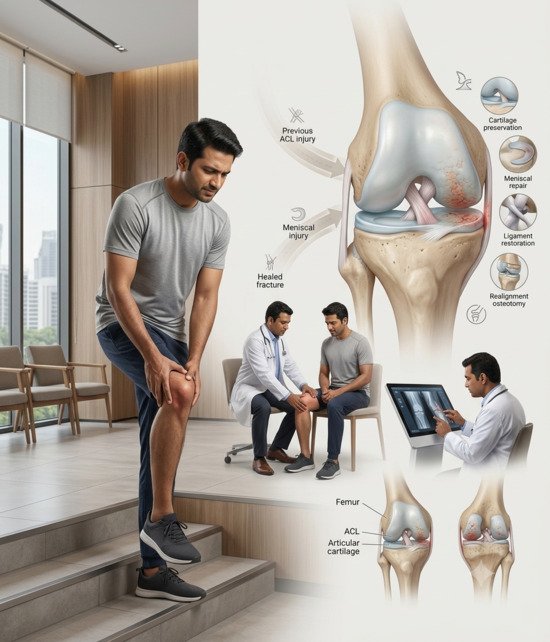
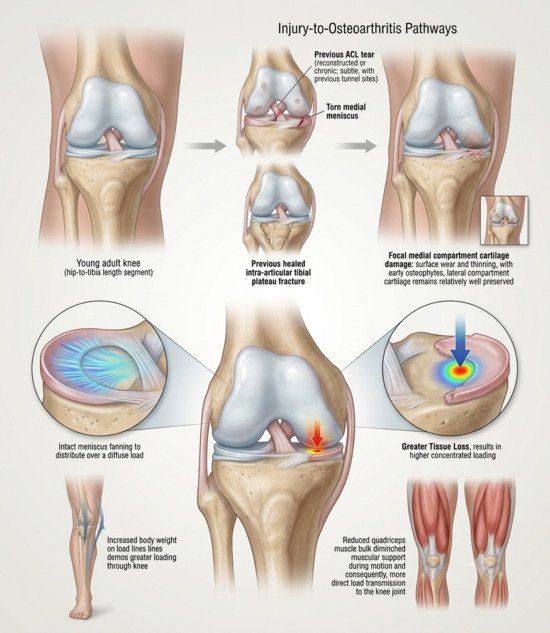
Why do young adults get knee arthritis?
Knee osteoarthritis in young adults is most commonly the result of a previous injury. The knee is a complex joint, and when it’s injured — whether through an ACL tear, a meniscal tear, or a fracture — the normal mechanics of the joint change. This altered loading pattern accelerates cartilage wear and leads to early-onset arthritis.
Meniscal injuries are particularly significant. The meniscus acts as a shock absorber, and when it’s torn or removed, the load on the cartilage increases dramatically. Research shows that the risk of arthritis increases as the amount of meniscal tissue removed increases. Other risk factors include obesity, which increases joint loads, and muscle weakness, which reduces the joint’s protection during activity.
What makes this different from age-related arthritis is that the joint is otherwise healthy. The cartilage damage is often confined to one area — usually the medial compartment — while the rest of the joint remains intact. This is important because it opens up options for joint preservation that aren’t available when arthritis is widespread.
Signs and symptoms
Knee arthritis in young adults can be subtle at first. The symptoms often start gradually and may be dismissed as a strain or overuse injury.
Pain with activity
A dull, aching pain that gets worse with activity — especially stairs, squatting, or running — and improves with rest.
Stiffness after rest
The knee feels stiff after sitting for a while or when you wake up in the morning, but loosens up with movement.
Swelling and flare-ups
Recurring swelling after activity, with periods of relative calm followed by painful flare-ups.
Giving way or instability
The knee may feel unstable or give way, especially if there’s associated ligament damage or muscle weakness.
Diagnosis
Diagnosis begins with a detailed history and physical examination. Dr. Kembhavi will assess your knee for alignment, stability, and range of motion, and look for signs of previous injury. Imaging is essential to confirm the diagnosis and stage the arthritis. Weight-bearing X-rays show joint space narrowing and the presence of osteophytes. An MRI may be ordered to assess the cartilage and menisci. In some cases, a CT scan is useful for planning surgery if malalignment is present.
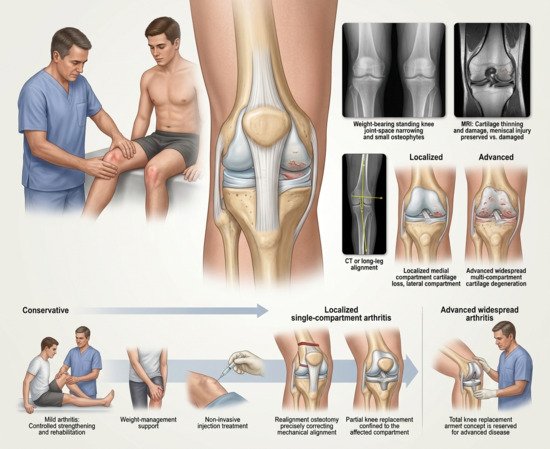
Imaging and assessment
Weight-bearing X-rays are the first step. They show the degree of joint space narrowing, the presence of bone spurs, and the overall alignment of the knee. MRI is useful for assessing the cartilage, menisci, and ligaments. CT scans or long-leg alignment films may be needed if malalignment is present and surgery is being considered. The goal is to determine whether the arthritis is confined to one compartment — which opens the door to joint preservation procedures — or involves the whole joint.
Treatment approach
Treatment is guided by one principle — preserve the natural joint for as long as possible. Mild arthritis is managed with physiotherapy, weight management, and injections. When damage is confined to one compartment, joint preservation options like realignment osteotomy or partial knee replacement come into play. Total knee replacement is reserved for advanced, widespread arthritis, since implant lifespan is finite and revision surgery in younger patients is more complex.
How knee arthritis in young adults is treated
Step 1
Physiotherapy & Lifestyle
Strengthening the quadriceps and hip muscles to improve joint stability and reduce load. Weight management if needed. Low-impact exercise encouraged.
Step 2
Injections & Biologics
Hyaluronic acid or PRP injections can reduce pain and improve function. These are non-surgical options that can provide temporary relief.
Step 3
Realignment Osteotomy
If arthritis is confined to one compartment and there’s malalignment, an osteotomy can redistribute load away from the damaged area and preserve the joint.
Step 4
Partial Knee Replacement
For isolated medial or lateral compartment arthritis, a partial (unicompartmental) knee replacement can preserve the healthy parts of the knee and offer faster recovery than total replacement.
Step 5
Total Knee Replacement (Last Resort)
Reserved for advanced, widespread arthritis. Modern implants and techniques can improve longevity for younger patients, but activity restrictions still apply.
Joint Preservation vs. Replacement
| Factor | Joint Preservation (Osteotomy/UKA) | Total Knee Replacement |
|---|---|---|
| Best for | Early to moderate arthritis, isolated compartment, younger patients | Advanced, widespread arthritis |
| Bone preservation | Preserves bone stock; less invasive | Resection of bone; more invasive |
| Activity level | Allows higher activity and sport | Activity restrictions; high-impact discouraged |
| Revision risk | Delays need for replacement by 10+ years | Implants last 15–20 years; revision more complex |
Why choose Dr. Raghavendra Kembhavi
Focus on joint preservation
For younger patients, the priority is preserving the natural knee. Dr. Kembhavi explores every option — osteotomy, partial replacement, cartilage procedures — before considering total knee replacement, because the implant lifespan is finite and revision surgery is more complex.
Comprehensive assessment
Not all knee arthritis is the same. Dr. Kembhavi assesses the pattern and extent of arthritis, alignment, and ligament stability to determine the most appropriate treatment for your specific situation.
Structured rehabilitation
Rehabilitation is critical to a good outcome. Dr. Kembhavi works closely with physiotherapists to ensure a structured programme that restores strength and function safely.
Realistic expectations
Knee arthritis is a chronic condition, and treatment focuses on managing symptoms and preserving function. Dr. Kembhavi will discuss realistic goals and timelines with you, so you know what to expect from your treatment journey.
Recovery timeline after joint preservation surgery
Recovery depends on the procedure. Joint preservation procedures generally allow a quicker return to activity than total knee replacement.
Weeks 0–6: Protection
Crutches and protected weight-bearing. Focus on reducing swelling and gentle range of motion. Bone healing begins.
Weeks 6–12: Motion & Strengthening
Progressive range of motion and strengthening. Walking without crutches. Return to light daily activities.
Months 3–6: Functional Training
Progressive strengthening and functional training. Low-impact activities like cycling and swimming are encouraged.
Month 6+: Return to Activity
Full return to activity and sport for many patients. Long-term monitoring of joint health and alignment.