Frozen Shoulder Treatment in Bangalore
It starts as a nagging ache in your shoulder, and before long you can’t reach for a seatbelt, fasten a bra, or sleep on that side. Then the stiffness sets in — and your shoulder simply stops moving the way it used to. This is frozen shoulder, a condition where the capsule around the joint becomes inflamed and contracts, progressively restricting movement.
Despite the name, it has nothing to do with cold weather. It’s a frustrating condition that follows a predictable pattern of pain, stiffness, and gradual recovery — but the process can take months, sometimes years. At our clinic in Bangalore, Dr. Raghavendra Kembhavi focuses on guiding patients through each phase with the right treatment at the right time, helping you recover movement faster and more comfortably.
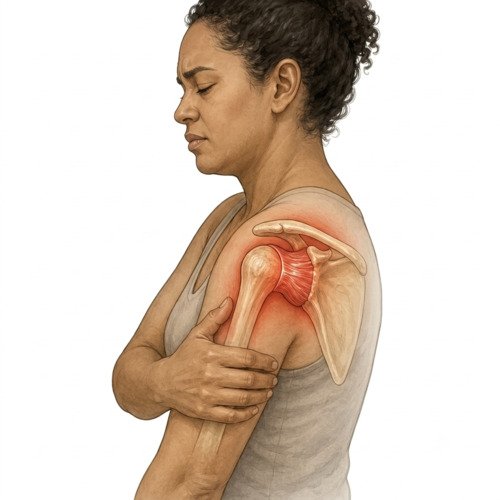
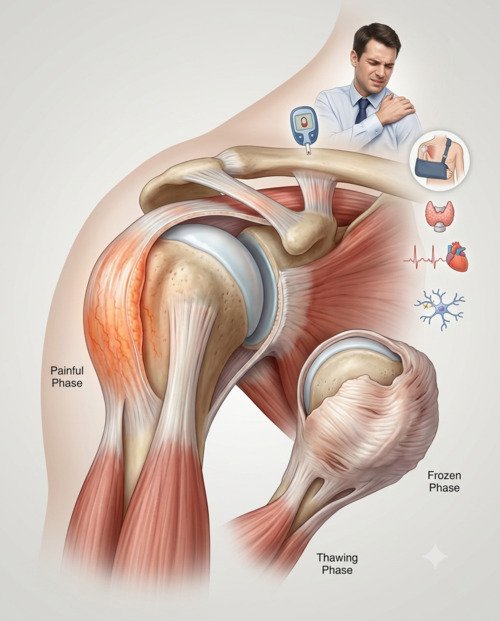
What is frozen shoulder, and why does it happen?
Frozen shoulder — medically called adhesive capsulitis — occurs when the capsule surrounding your shoulder joint becomes inflamed and progressively tightens. This capsule is normally a loose bag that allows your shoulder to move freely. When it contracts, movement becomes restricted, and the joint literally “freezes”.
The exact cause isn’t fully understood, but certain factors clearly increase risk. Diabetes is the strongest link — people with diabetes are 2 to 4 times more likely to develop frozen shoulder, and the condition tends to be more severe and longer-lasting. Thyroid disorders, heart disease, and Parkinson’s disease are also associated. A period of shoulder immobilisation after injury or surgery can trigger it too.
What makes frozen shoulder distinctive is its timeline. It’s not a sudden injury that heals in weeks. Instead, it moves through three phases — painful, frozen, and thawing — and the entire process can take anywhere from 12 months to 4 years if left untreated. The good news is that it is self-limiting, meaning it does eventually resolve on its own in most people. But “eventually” can feel like a very long time when you can’t use your arm normally.
Signs and symptoms
Frozen shoulder symptoms evolve over time, following a fairly predictable pattern. What starts as pain gradually gives way to stiffness, and eventually the shoulder loosens again.
Night pain
Pain that is often worse at night and disturbs sleep. Lying on the affected side becomes impossible.
Loss of movement
External rotation is usually lost first, followed by abduction and internal rotation. Reaching behind your back or overhead becomes difficult.
Stiffness in all directions
Unlike many shoulder conditions, frozen shoulder restricts both active and passive movement — even when someone else tries to move your arm.
Gradual onset
Symptoms usually come on slowly, without a specific injury. It can take weeks before you realise something is seriously wrong.
Diagnosis
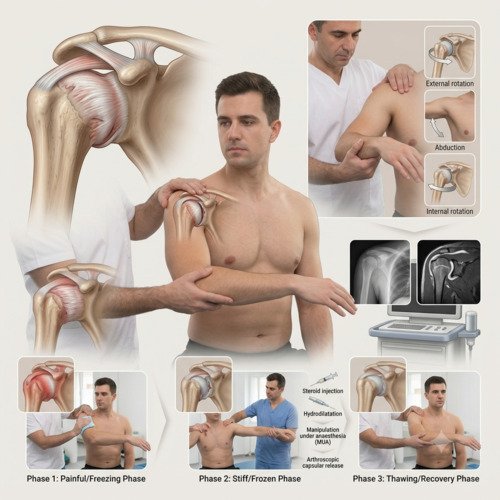
Frozen shoulder is usually diagnosed clinically, based on your history and examination. The classic finding is a “capsular pattern” of restriction — external rotation is most affected, followed by abduction and internal rotation. Both active and passive movement are limited to a similar degree, which helps distinguish it from other shoulder conditions.
Imaging and tests
X-rays are typically normal in frozen shoulder, but they’re useful to rule out other causes like arthritis or avascular necrosis. An MRI may show thickening of the joint capsule and reduced joint volume, but it’s not always necessary for diagnosis. The key is the clinical picture — the characteristic pattern of stiffness and the history of gradual onset.
The three phases
Understanding which phase you’re in matters, because the treatment focus shifts as you progress. The painful (freezing) phase lasts 2–9 months and is dominated by pain. The stiff (frozen) phase lasts 4–12 months, where pain may ease but stiffness is at its worst. The thawing (recovery) phase lasts 5–28 months, where movement gradually returns.
Treatment approach
Treatment is tailored to the phase. In the painful phase, the focus is on pain relief — anti-inflammatories, steroid injections, and gentle movement. In the stiff phase, the emphasis shifts to physiotherapy and stretching to regain range of motion. In the thawing phase, continued exercise helps consolidate gains. For cases that don’t respond, procedures like hydrodilatation, manipulation under anaesthesia, or arthroscopic capsular release can help.
How frozen shoulder is treated
Step 1
Pain Control
Anti-inflammatory medications and activity modification. The goal is to make you comfortable enough to start moving.
Step 2
Steroid Injection
An intra-articular corticosteroid injection can provide rapid pain relief, particularly in the early painful phase. Research shows intra-articular injections are more effective than subacromial ones.
Step 3
Physiotherapy
Gentle stretching and range-of-motion exercises. Once pain is controlled, therapy focuses on regaining movement.
Step 4
Hydrodilatation
A high-pressure injection of fluid stretches the contracted capsule. Ultrasound-guided hydrodilatation with hyaluronic acid combined with physiotherapy has shown superior outcomes.
Step 5
Manipulation Under Anaesthesia
The shoulder is gently moved through its range while you’re asleep. A recent study showed MUA under brachial plexus block significantly improved ROM and shortened return-to-work time compared to conservative treatment.
Step 6
Arthroscopic Capsular Release
Keyhole surgery to divide the tight capsule. Reserved for cases that fail 9–12 months of non-surgical treatment. Allows direct visualisation and treatment.
Arthroscopic release vs. non-surgical treatment
| Factor | Arthroscopic Capsular Release | Non-Surgical Treatment |
|---|---|---|
| Best for | Failed 9–12 months of non-surgical care, severe stiffness | First-line for all patients; most cases resolve without surgery |
| Pain relief | Direct release of contracted capsule; reliable and rapid | Gradual; steroid injections provide early relief |
| Recovery time | Desk work 1–2 weeks; full recovery 3–6 months | Natural history 1–4 years; symptoms improve over time |
| Joint preservation | Capsule released; joint structure preserved | Capsule preserved; relies on natural thawing process |
Why choose Dr. Raghavendra Kembhavi
Phase-based treatment approach
Frozen shoulder isn’t a single condition — it moves through phases, and the right treatment depends on where you are. Dr. Kembhavi takes the time to identify your phase and tailor the approach accordingly, avoiding interventions that might worsen the pain during the freezing phase.
A focus on getting you moving
The goal is always to restore movement — whether through targeted therapy, injections, or surgery. Dr. Kembhavi works closely with physiotherapists to ensure you get the right balance of rest and activity at each stage.
Advanced arthroscopic skills
When surgery is needed, Dr. Kembhavi performs arthroscopic capsular release through small keyhole incisions. This allows direct visualisation of the contracted capsule and precise release of the tight tissue, with less trauma than open surgery.
Understanding the natural history
Frozen shoulder is self-limiting — it does eventually resolve. But “eventually” can mean years. Dr. Kembhavi helps you navigate the process, offering interventions when appropriate to speed recovery and maintain function.
Recovery timeline after arthroscopic release
Recovery from arthroscopic release is usually quicker than waiting for the natural thawing process. The key is early and consistent physiotherapy to maintain the range gained during surgery.
Week 0–2
No sling needed. Immediate gentle movement. Physiotherapy begins within days to maintain the range gained during surgery.
Week 2–6
Active range of motion restored. Light daily activities resume. Return to desk work often possible.
Week 6–12
Progressive strengthening. Full range of motion typically regained. Gradual return to more demanding activities.
Month 3+
Full recovery for most patients. Return to unrestricted activity, including sports and heavy lifting.