Pectoralis Major Tendon Tear Treatment in Bangalore
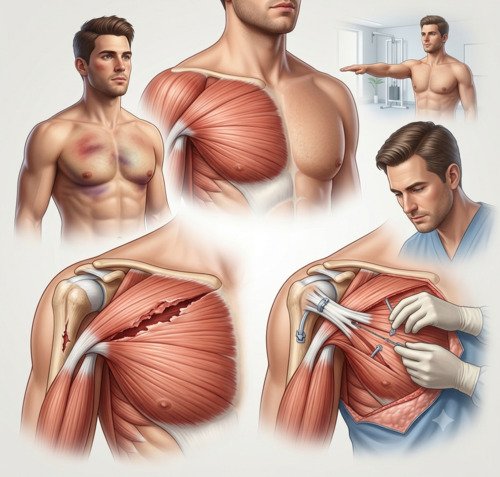
You felt a sudden pop in your chest during a bench press or a heavy lift, followed by pain, bruising, and a visible change in the shape of your chest. This is the classic presentation of a pectoralis major tendon tear — an injury most common in weightlifters and athletes.
The pectoralis major is the large muscle across your chest, and its tendon attaches to the upper arm. When it tears, you lose strength in pushing and rotating movements. At our clinic in Bangalore, Dr. Raghavendra Kembhavi specialises in diagnosing and surgically repairing these injuries, helping patients regain their strength and chest contour.
What causes a pectoralis major tear?
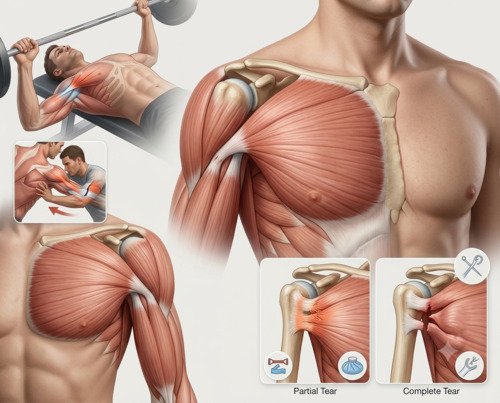
The pectoralis major tendon usually tears during a sudden, forceful movement — most often the bench press, especially when the bar is lowered too far or lifted with poor form. It can also happen during wrestling, rugby, or any activity involving a strong pushing or pulling motion.
Tears are classified as partial or complete, and by location. Most occur at the tendon’s attachment to the humerus. Complete tears in active individuals almost always require surgical repair to restore strength and chest contour. Partial tears may heal with conservative treatment, depending on the extent of the damage.
Signs and symptoms
A pectoralis major tear has a fairly distinctive presentation, especially when the tendon is completely ruptured.
Sudden pop and pain
A sharp pop at the time of injury, followed by immediate pain in the chest or upper arm.
Bruising and swelling
Bruising appearing over the chest, upper arm, or even down to the elbow in the days after injury.
Visible deformity
A change in the shape of the chest, with the muscle appearing to bunch up toward the armpit. This is the most telling sign.
Weakness in pushing
Noticeable loss of strength in pushing movements, hugging, or rotating the arm inward.
Diagnosis
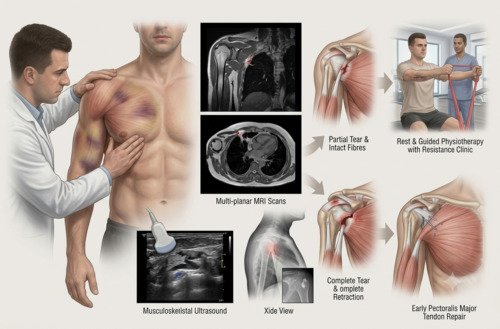
Diagnosis is usually clinical, based on your history and examination. Dr. Kembhavi will look for the characteristic deformity, bruising, and weakness. An MRI confirms the diagnosis and shows whether the tear is partial or complete — this distinction is important because it guides the treatment decision.
Imaging and confirmation
An MRI is the imaging study of choice. It shows whether the tendon is partially or completely torn, and how far it has retracted. Ultrasound can also be useful and is sometimes used to guide injections or confirm the diagnosis in the clinic. X-rays are usually normal but may show a small avulsion fracture in some cases.
Treatment approach
Treatment depends on whether the tear is partial or complete, and your activity level. Partial tears are usually managed conservatively with rest and physiotherapy. Complete tears in active individuals — especially those who want to return to strength training or sport — are best treated with surgical repair. Repair within the first few weeks of injury gives the best results, before the tendon retracts and scar tissue forms.
How pectoralis major tears are treated
Step 1
Immediate Care
Rest, ice, and immobilisation in a sling. Avoid any pushing or lifting until you’ve been assessed.
Step 2
Diagnostic MRI
An MRI confirms whether the tear is partial or complete and assesses the degree of tendon retraction.
Step 3
Conservative Care (Partial Tears)
Physiotherapy to restore movement and strength, with a gradual return to activity over 6–12 weeks.
Step 4
Surgical Repair (Complete Tears)
The tendon is reattached to the humerus using suture anchors. Best results when performed within 4–6 weeks of injury.
Step 5
Post-Operative Rehabilitation
A structured programme to protect the repair and progressively restore strength and function.
Step 6
Return to Sport
Gradual return to training, with full return to heavy lifting and contact sport typically by 4–6 months.
Surgical repair vs. conservative treatment
| Factor | Surgical Repair | Conservative Treatment |
|---|---|---|
| Best for | Complete tears in active individuals | Partial tears, low-demand patients |
| Strength recovery | Significantly better than conservative care | May remain weak, especially in pushing |
| Cosmetic outcome | Restores chest contour | Deformity often persists |
| Recovery time | Sling 4–6 weeks; full recovery 4–6 months | No downtime; gradual return over 6–12 weeks |
Why choose Dr. Raghavendra Kembhavi
Early repair gives the best results
Timing matters with pectoralis major tears. Repair within 4–6 weeks of injury gives significantly better outcomes than delayed surgery, before the tendon retracts and scar tissue forms. Dr. Kembhavi prioritises prompt assessment and treatment.
Strength and cosmetic restoration
For active individuals, surgical repair not only restores strength but also corrects the chest deformity. Dr. Kembhavi’s technique focuses on both — helping you return to training with confidence.
A structured rehabilitation approach
Repair is only half the journey. Dr. Kembhavi works with physiotherapists to ensure a structured rehabilitation programme that protects the repair and progressively restores strength, with a clear timetable for return to sport.
Accurate diagnosis matters
Not every chest injury is a pectoralis tear. Dr. Kembhavi uses MRI to confirm the diagnosis and distinguish between partial and complete tears — because the treatment pathways are completely different.
Recovery timeline after surgical repair
Recovery is phased and requires patience. The tendon needs time to heal to bone before it can be loaded.
Week 0–4: Protection
Sling worn continuously. No active movement of the operated arm. Gentle passive motion starts after 2 weeks.
Week 4–8: Active Movement
Sling discontinued. Active-assisted to active range of motion. Light daily activities resume.
Week 8–16: Strengthening
Progressive strengthening begins. Light resistance work around week 10, advancing as comfort allows.
Month 4–6: Return to Sport
Return to gym and heavy lifting guided by strength testing. Contact sport typically allowed after 6 months.