Anterior Cruciate Ligament (ACL) Tear Revision Treatment in Bangalore
You had ACL reconstruction surgery. You went through the rehabilitation. And now, somehow, it’s happened again — the same instability, the same giving way, the same feeling that your knee just isn’t reliable. For anyone who has already been through ACL surgery, facing the possibility of a revision is frustrating and disheartening.
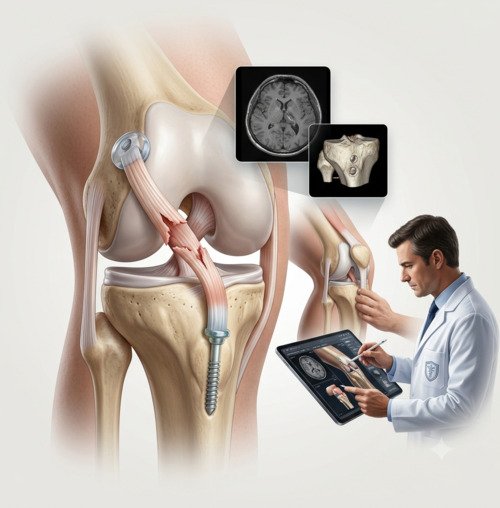
Revision ACL reconstruction is a more complex procedure than the first surgery. It requires careful evaluation of why the original graft failed, precise planning, and often additional procedures to address underlying issues. At our clinic in Bangalore, Dr. Raghavendra Kembhavi specialises in complex revision ACL surgery — bringing the detailed assessment and technical expertise needed to get your knee back on track.
Why does an ACL reconstruction fail?
ACL reconstruction is a highly successful operation, with success rates ranging from 75% to 97%. However, a small percentage of grafts do fail, and understanding why is the first step in planning a successful revision. Failure rates for revision ACLR are higher than primary surgery — approximately 13.7% in athletes.
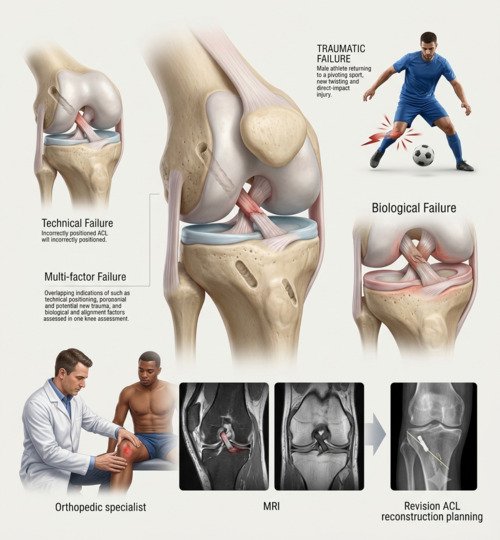
The most common causes of graft failure fall into three categories. Technical factors include improper tunnel placement, which was identified in 40% of revision cases in one study. Traumatic factors include a new injury to the graft, often from returning to sport too early or a direct blow. Biological factors include failure of the graft to incorporate, infection, or underlying alignment issues like excessive posterior tibial slope.
In many cases, multiple factors contribute. One study found that 45% of revision patients had more than one reason for graft failure. This is why a thorough evaluation is essential before planning revision surgery.
Signs of a failed ACL graft
A failed ACL graft doesn’t always present dramatically. Some patients experience a sudden re-injury; others notice gradual instability over time.
Recurrent instability
The knee gives way again, especially with pivoting or twisting movements — the same feeling you had before your first surgery.
New injury with a pop
A sudden twisting injury that reproduces the original symptoms, often with a pop and rapid swelling.
Gradual loss of confidence
Some patients don’t have a specific injury but notice their knee feels less stable over time, especially with sport.
Pain and swelling
New or recurrent pain and swelling in the knee, especially after activity, may indicate graft failure or associated injury.
Diagnosis and Planning
Revision ACL surgery requires a more detailed evaluation than primary surgery. Dr. Kembhavi begins by reviewing your previous operative notes, imaging, and rehabilitation history — understanding exactly what was done and why it failed is essential for planning the revision.
Imaging and assessment
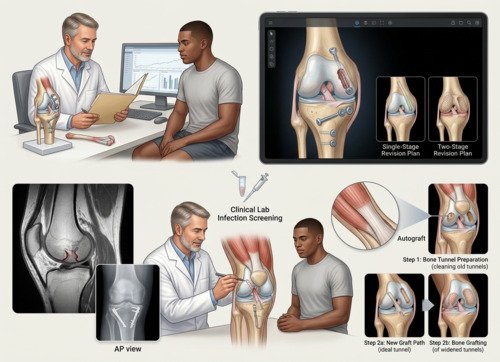
X-rays assess tunnel position, implant status, and joint space. A CT scan is often more useful than MRI for revision planning — it provides precise measurement of tunnel widening and helps determine whether a one-stage or two-stage revision is needed. MRI may be used to assess associated meniscal or cartilage injuries. Infection must always be ruled out before revision surgery.
Treatment approach
Revision ACL surgery is more complex than primary reconstruction. Key considerations include graft choice (autograft is strongly preferred — patients receiving autografts are 2.78 times less likely to experience a re-rupture compared to allografts, tunnel management (one-stage vs. two-stage), and whether additional procedures like anterolateral ligament reconstruction or slope-reducing osteotomy are needed. Dr. Kembhavi will discuss all options with you and develop a personalised surgical plan.
How revision ACL surgery is performed
Step 1
Detailed Evaluation
Review of previous operative notes, imaging, and rehabilitation. CT scan for tunnel assessment. Infection ruled out.
Step 2
Surgical Planning
Decision on one-stage vs. two-stage revision, graft choice (autograft preferred), and any additional procedures needed.
Step 3
Graft Removal & Tunnel Preparation
The old graft and hardware are removed. New tunnels are created, avoiding the previous tunnel paths.
Step 4
New Graft Reconstruction
A new graft is passed through the tunnels and secured with fixation devices. Autograft is strongly preferred for revision surgery.
Step 5
Associated Procedures
Meniscal repair, cartilage treatment, or extra-articular procedures (like ALL reconstruction) performed as needed.
Step 6
Rehabilitation
A structured programme tailored to the revision procedure, with careful attention to graft protection and return to sport criteria.
One-stage vs. Two-stage Revision
| Factor | One-Stage Revision | Two-Stage Revision |
|---|---|---|
| Best for | Properly positioned tunnels, minimal widening, no infection | Severe tunnel widening (15mm+), infection, arthrofibrosis |
| Number of surgeries | Single procedure | Two procedures (removal + reconstruction after healing) |
| Recovery timeline | Standard ACL recovery protocol | Extended timeline due to staged approach |
| Graft options | Autograft preferred; bone grafting may be needed | Autograft preferred; bone graft performed at first stage |
Why choose Dr. Raghavendra Kembhavi
Experience with complex revision surgery
Revision ACL surgery requires a different skill set than primary reconstruction. Dr. Kembhavi has the experience to manage tunnel issues, graft selection, and associated procedures — the details that determine revision success.
Criterion-based rehabilitation
Return to sport isn’t based on time alone — it’s based on objective strength and functional testing. Dr. Kembhavi works closely with physiotherapists to ensure you’re truly ready before clearing you for full activity.
Personalised surgical planning
Every revision case is different. Dr. Kembhavi takes the time to understand your specific situation — why the first surgery failed, what needs to be corrected, and what your goals are — before recommending a surgical plan.
Realistic expectations
Revision ACL surgery has good outcomes, but they’re generally not quite as good as primary reconstruction. Dr. Kembhavi will discuss realistic expectations with you, so you know what to expect from recovery and return to sport.
Recovery timeline after revision ACL surgery
Recovery after revision surgery follows a similar timeline to primary ACL reconstruction, but return to sport may take longer. Patient expectations should be tempered, as functional outcomes and return to pre-injury sports are usually inferior to primary surgery.
Weeks 0–6: Protection & Motion
Crutches and brace. Focus on reducing swelling, restoring range of motion, and activating the quadriceps.
Weeks 6–12: Strengthening
Progressive strengthening, balance training, and neuromuscular re-education. Walking without crutches.
Months 3–6: Advanced Training
Running, agility drills, and plyometrics introduced when strength criteria are met. Sport-specific training begins.
Months 9–12: Return to Sport
Criterion-based return to sport when strength and hop testing reach 90% of the uninvolved side. May take longer than primary ACL recovery.