Patellar Tendon Tear Treatment in Bangalore
You felt a pop at the front of your knee, followed by immediate pain and an inability to straighten your leg. When you try to stand, your knee buckles. This is the classic presentation of a patellar tendon tear — a serious injury that disrupts the extensor mechanism of the knee.
The patellar tendon connects your kneecap to your shin bone and is essential for straightening your knee. When it ruptures, the connection between your quadriceps muscle and your lower leg is lost. You cannot actively extend your knee, and walking becomes difficult or impossible without support. This is a surgical emergency in most cases, and prompt treatment is essential for a good outcome. At our clinic in Bangalore, Dr. Raghavendra Kembhavi specialises in patellar tendon repair and reconstruction, with a focus on restoring the extensor mechanism and getting you back on your feet.
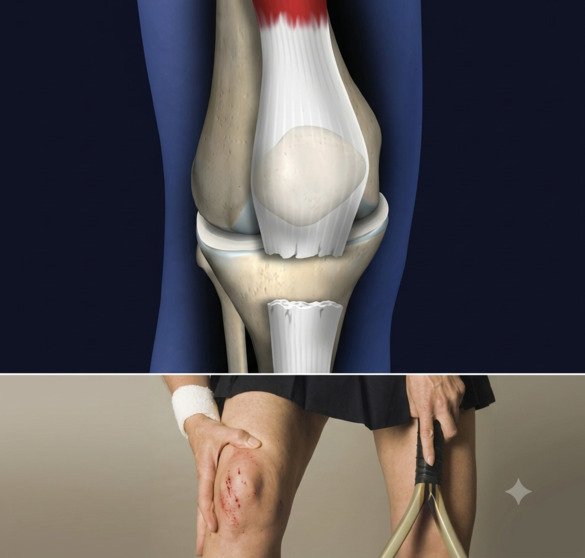
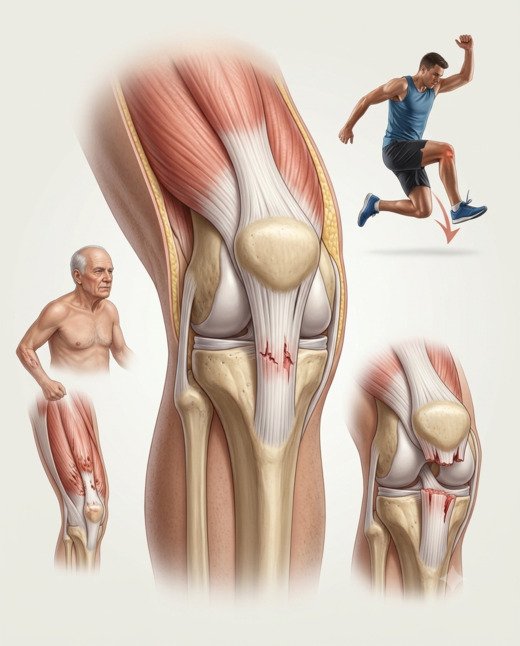
What is the patellar tendon, and how do tears happen?
The patellar tendon is a strong band of tissue that connects the bottom of your kneecap (patella) to the tibial tubercle — the bony bump on the front of your shin bone. Together with the quadriceps tendon above the kneecap, it forms the extensor mechanism — the system that allows you to straighten your knee.
Patellar tendon tears are less common than ACL or meniscal injuries, accounting for approximately 0.5% of the general population each year. However, they are serious injuries that require prompt attention. The tendon is remarkably strong — it requires a force of approximately 17.5 times body weight to rupture. This means that in healthy individuals, a tear usually requires a significant force, such as a sudden jump or a direct blow to the knee. In older adults, or those with a history of tendinitis or corticosteroid injections, the tendon may be weaker and can tear with less force.
Tears can be complete or partial. A complete tear means the tendon has ruptured entirely, and you cannot straighten your knee. A partial tear means some fibres remain intact, and you may retain some ability to extend the knee. Complete tears are surgical emergencies, while partial tears may sometimes be managed conservatively.
Signs and symptoms
The symptoms of a patellar tendon tear are dramatic and usually unmistakable. The inability to straighten the knee is the hallmark.
Inability to straighten the knee
The most definitive sign. When the tendon is completely torn, you cannot actively extend your knee, even if someone tries to help you.
A palpable gap
A defect or gap can often be felt just below the kneecap where the tendon has ruptured. The patella may also sit higher than normal (patella alta).
A pop at the time of injury
Many patients hear or feel a pop or rip at the front of the knee when the tendon tears.
Swelling and bruising
Swelling develops rapidly, and bruising appears over the front of the knee within 48 hours.
Diagnosis
Diagnosis is usually straightforward. Dr. Kembhavi will take a detailed history and perform a physical examination, looking for the classic signs — the palpable gap, the inability to straighten the knee, and the high-riding patella. X-rays are essential to confirm patella alta and rule out fractures. An MRI may be ordered to assess the extent of the tear and identify any associated injuries, particularly if there’s suspicion of a multi-ligament knee injury.
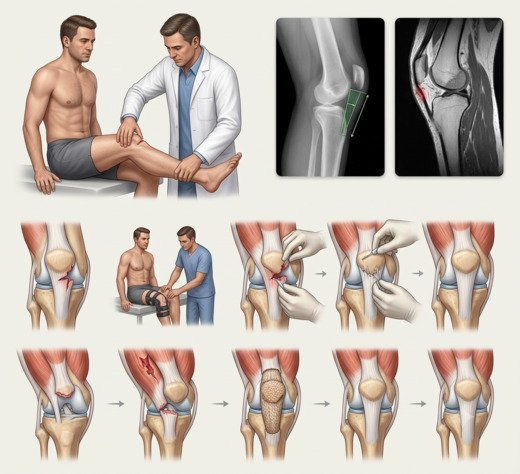
Imaging and assessment
X-rays are essential — they show the position of the patella. In a complete tear, the patella rides high (patella alta), and the Insall-Salvati ratio is increased. MRI confirms the diagnosis and assesses the extent of the tear, as well as any associated injuries like meniscal tears, ligament injuries, or fractures. In chronic or neglected cases, MRI also helps assess the quality of the remaining tendon and the degree of quadriceps retraction.
Treatment approach
Complete patellar tendon tears require surgery. There is no role for non-surgical treatment when the extensor mechanism is disrupted — the tendon ends will not heal together without surgical repair. The goal is to restore the continuity of the extensor mechanism, reattach the tendon to the patella, and restore normal patellar height. Partial tears may sometimes be managed conservatively with bracing and physiotherapy, but this depends on the extent of the tear and the patient’s functional needs. Chronic or neglected tears — where treatment has been delayed — require reconstruction using a tendon graft, as the tendon ends have retracted and cannot be directly repaired.
How patellar tendon tears are treated
Step 1
Immediate Care
Immobilisation in a knee brace locked in extension. Ice, elevation, and crutches. Non-weight-bearing until assessed.
Step 2
Diagnosis & Planning
X-rays and MRI confirm the diagnosis and assess the extent of the tear. Surgical repair is planned.
Step 3
Surgical Repair
The tendon is reattached to the patella using strong sutures passed through bone tunnels or suture anchors. The repair is protected with a brace.
Step 4
Augmentation (If Needed)
For chronic or neglected tears, a tendon graft (such as semitendinosus) is used to reconstruct the tendon and bridge the gap .
Step 5
Structured Rehabilitation
A phased programme that protects the repair while restoring range of motion and strength, with clear milestones for progression.
Step 6
Return to Activity
Gradual return to daily activities and, for some patients, sport. Full recovery typically takes 6–9 months.
Primary Repair vs. Reconstruction
| Factor | Primary Repair | Reconstruction (Graft) |
|---|---|---|
| Best for | Acute tears (within 2–3 weeks), good tendon quality | Chronic/neglected tears, poor tendon quality, retracted ends |
| Technique | Tendon reattached directly to patella with sutures through bone tunnels | Graft used to bridge the gap and reconstruct the tendon |
| Recovery time | Standard protocol; full recovery 6–9 months | Longer due to graft incorporation; outcomes generally inferior to acute repair |
| Return to sport | High rates of return (88.9% overall, 80.8% same level) | May be limited; high-impact activities may not be possible |
Why choose Dr. Raghavendra Kembhavi
Experience with complex extensor mechanism injuries
Patellar tendon tears — especially chronic or neglected cases — require careful surgical planning and technique. Dr. Kembhavi has experience in both acute repair and complex reconstruction, using grafts when needed to restore the extensor mechanism.
Structured rehabilitation
Rehabilitation after patellar tendon repair is critical. Dr. Kembhavi works closely with physiotherapists to ensure a structured programme that protects the repair and restores function safely.
Prompt treatment matters
Acute repairs have better outcomes than reconstructions for chronic tears. Early diagnosis and treatment are key. Dr. Kembhavi prioritises prompt assessment and surgical intervention when needed.
Comprehensive knee assessment
Patellar tendon tears can occur alongside other knee injuries. Dr. Kembhavi’s thorough diagnostic process identifies associated ligament, meniscal, or cartilage injuries, ensuring they’re addressed in the same treatment plan.
Recovery timeline after patellar tendon repair
Recovery is deliberate and phased. The repair must be protected while it heals, and progression is based on achieving specific milestones.
Weeks 0–3: Protection
Knee immobilised in a brace locked in extension. Non-weight-bearing with crutches. Passive range of motion begins, limited to 30° initially.
Weeks 3–6: Progressive Motion
Range of motion progresses to 90° by week 6. Weight-bearing begins as tolerated with the brace. Isometric quadriceps exercises start.
Weeks 6–12: Strengthening
Progressive strengthening and active range of motion. Full weight-bearing. Extension lag is monitored and addressed with targeted exercises.
Months 4–9: Return to Sport
Return to sports is typically possible after 6–9 months. High rates of return to play have been reported (88.9%), with most returning to the same level.