Knee Replacement Surgery in Bangalore for Knee Arthritis and Joint Damage
Introductory Paragraph
Severe knee pain, stiffness and advanced joint damage can make walking and everyday activities difficult. Knee replacement surgery may be considered for certain patients when knee arthritis or other joint conditions significantly affect mobility and non-surgical treatments are insufficient. Dr. Raghavendra Kembhavi provides orthopaedic evaluation to help patients understand their condition and explore appropriate treatment options. If you are looking for a knee replacement surgeon in Bangalore, consult the clinic to discuss your symptoms and suitability for treatment.
Knee replacement is designed to replace damaged joint surfaces with artificial components, helping reduce pain and improve knee function.
What is knee replacement surgery?
Knee replacement (knee arthroplasty) is a surgical procedure that removes damaged cartilage and bone from the surface of an arthritic knee joint and resurfaces it with metal and plastic implant components. It relieves pain and restores function when the joint has worn down beyond what non-surgical treatment or arthroscopy can address.
Dr. Raghavendra Kembhavi performs total knee replacement, partial (unicompartmental) knee replacement, and robotic-assisted knee replacement in Bangalore, matching the technique to each patient’s specific pattern of joint damage, age, and activity goals.
Total, partial & robotic-assisted knee replacement Surgery in Bangalore
The right technique depends on how much of the joint is damaged, your age, activity level and bone quality.
Total Knee Replacement
Resurfaces all three compartments of the knee. Recommended when arthritis has damaged multiple areas of the joint, offering durable, long-term pain relief.
Partial Replacement
Resurfaces only the damaged compartment, leaving healthy bone, cartilage and ligaments intact. Suited to arthritis confined to one part of the knee, with a typically faster recovery.
Robotic-Assisted Replacement
Uses 3D imaging and real-time navigation to plan implant position and balance soft tissue with high precision, for either total or partial replacement.
Complex & Revision Surgery
For patients needing a repeat procedure due to implant wear, loosening or complications from a prior replacement, restoring function with a revised implant.
Signs you may need knee replacement
These signs suggest it’s time for a surgical evaluation, particularly if non-surgical treatment has already been tried.
- Knee pain that persists despite physiotherapy, medication or injections
- Pain that disturbs sleep or occurs even at rest
- Significant stiffness limiting bending or straightening the knee
- Visible knee deformity — bowing inward or outward
- Difficulty walking, climbing stairs, or rising from a chair
- X-rays showing bone-on-bone contact or advanced joint space loss
- Reduced quality of life due to chronic knee pain
- Reliance on walking aids for basic mobility
Risks & considerations
Serious complications are uncommon with proper assessment and post-operative care, but every surgery carries risk.
Infection
A small risk with any surgery, minimised with sterile technique and antibiotic protocols.
Blood Clots
Reduced through early mobilisation, compression measures and, when needed, blood-thinning medication.
Stiffness
Managed with structured physiotherapy starting soon after surgery to maintain range of motion.
Implant Wear Over Time
Modern implants last 15–20+ years; younger, more active patients may eventually need a revision.
Anaesthesia-Related Risk
Assessed and managed by an anaesthesia team based on your individual fitness for surgery.
Nerve or Vessel Injury
Rare, and minimised through careful surgical technique and experience.
How knee replacement surgery is performed
Step 1
Pre-Operative Assessment
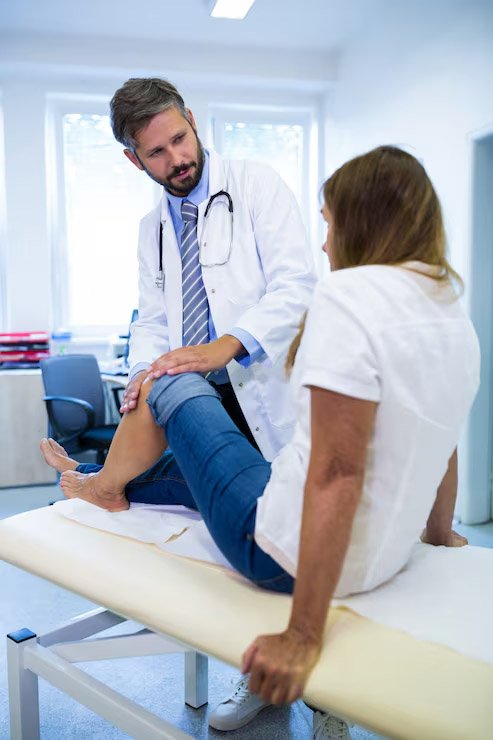
Clinical examination, imaging, blood tests and anaesthesia fitness evaluation to plan the surgery.
Step 2
Anaesthesia
Performed under spinal or general anaesthesia, based on your health profile and preference.
Step 3
Joint Resurfacing
Damaged bone and cartilage are removed and the joint surfaces are precisely shaped to accept the implant.
Step 4
Implant Placement
Metal and plastic implant components are fitted and aligned, guided by conventional or robotic-assisted instrumentation.
Step 5
Closure
The incision is closed in layers, and pain management begins immediately in the recovery room.
Step 6
Early Mobilisation
Physiotherapy typically begins within 24 hours to encourage safe, early walking with support.
Total vs. partial knee replacement
Total knee replacement replaces the damaged surfaces across the affected compartments of the knee and is generally considered when arthritis is widespread. Partial knee replacement treats only the damaged compartment while preserving healthy parts of the knee, making it suitable for carefully selected patients with more localised arthritis.
| Factor | Total Knee Replacement | Partial Knee Replacement |
|---|---|---|
| Joint area treated | All three compartments | One damaged compartment |
| Bone & ligament preservation | Less preserved | More natural bone and ligaments retained |
| Typical recovery | 3–6 months for full recovery | Often faster, 6–10 weeks |
| Best suited for | Multi-compartment arthritis | Arthritis confined to one compartment |
| Revision likelihood | Lower over implant lifetime | Slightly higher if arthritis progresses |
Who benefits most from knee replacement
Good candidates typically have:
- Advanced osteoarthritis with significant joint space loss on imaging
- Persistent pain despite a full trial of non-surgical treatment
- Knee deformity affecting alignment and gait
- Reduced quality of life or mobility due to knee pain
- Reasonable overall fitness for surgery and rehabilitation
Surgery may be delayed or reconsidered when:
- Symptoms are still manageable with non-surgical treatment
- Arthritis is early-stage without significant structural damage
- Active infection is present anywhere in the body
- Underlying health conditions need optimisation before major surgery
A detailed recovery timeline
Recovery is gradual and closely guided by physiotherapy — most patients see steady improvement for up to a year.
Day 0–1: Surgery & First Walk
Surgery is performed, and physiotherapy-assisted standing or walking with a frame typically begins within 24 hours.
Day 2–5: Hospital Stay
Pain management, wound care and daily physiotherapy sessions focused on safe mobility before discharge.
Week 1–2: Early Home Recovery
Continued physiotherapy, icing and elevation; walking distance gradually increases with a frame or crutches.
Week 3–6: Building Strength
Transition from walking aids as strength improves; range-of-motion and strengthening exercises intensify.
Month 3–6: Full Daily Function
Normal daily activities resume fully; strength and endurance continue to build with ongoing exercise.
Month 6–12: Peak Recovery
Most patients reach their best functional outcome, with continued gradual improvement in strength and confidence.
Fellowship-trained, sports medicine focused
Dr. Raghavendra Kembhavi is a fellowship-trained Orthopaedic Surgeon and Sports Medicine Specialist offering minimally invasive arthroscopic care for hip, knee and shoulder conditions in Bangalore.

10000+
Successful Patient Consultations

3000+
Orthopaedic & Sports Injury Treatments

2500+
Arthroscopic & Joint Procedures

17+
Years of Trusted Experience